


Innovation
Brave AI - a proactive care intelligence platform that identifies unmet need, enabling integrated neighbourhood teams to deliver proactive care
Project Lead
Dr Ignat Drozdov, CEO

About
The NHS faces a growing challenge of reactive, fragmented care that fails to identify patients with unmet need before they deteriorate. Integrated Neighbourhood Teams lack the tools to systematically surface at-risk populations and translate data insights into coordinated proactive action.
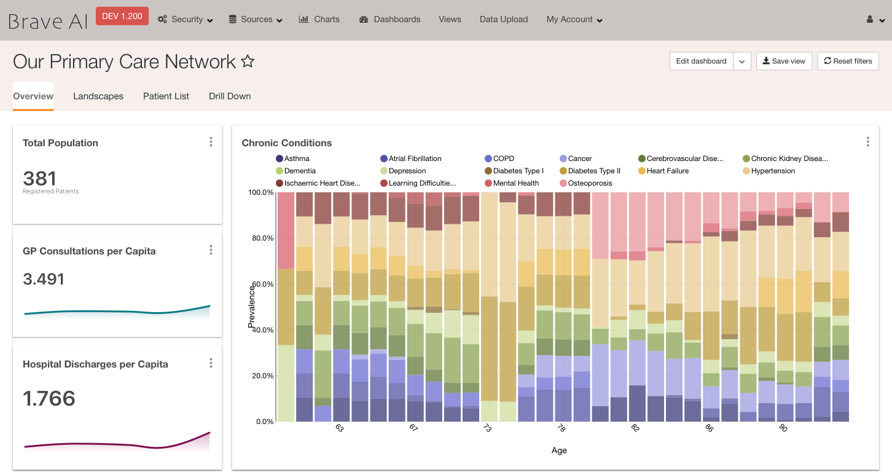
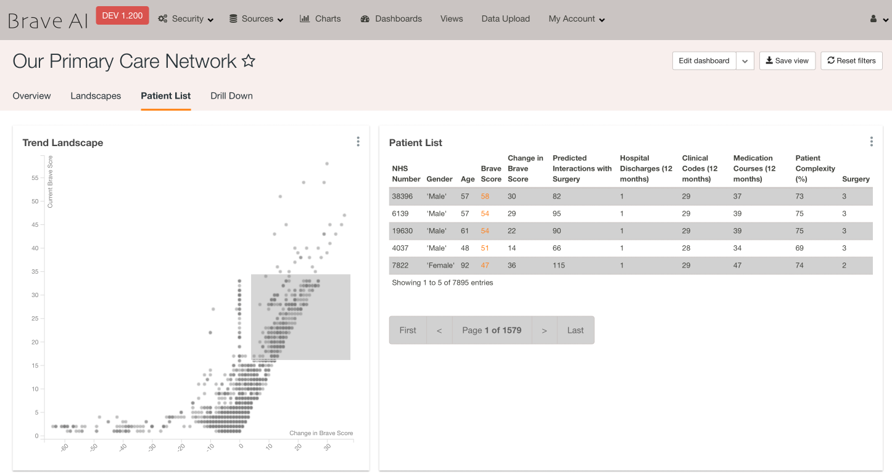
Brave AI addresses this by combining machine learning-driven case finding with a population health management platform, generating personalised risk, demand, and complexity scores from routine primary care records. Unlike conventional tools that focus only on the highest-risk individuals, Brave AI identifies patients with emerging, actionable need, surfacing patients most likely to benefit from early intervention but not yet on clinical radar.
Brave AI directly targets the CORE20PLUS5 "PLUS" groups, specifically people living with moderate and severe frailty, those with multiple long-term conditions, people with learning disabilities, people with dementia, housebound individuals, and care home residents, all groups who disproportionately experience poor health outcomes and face the greatest barriers to accessing proactive care.
Brave AI is designed to address the inverse care law: identifying patients with the highest need who are least likely to self-present or be visible through routine clinical contact, and proactively bringing care to them.
What makes Brave AI uniquely value-adding is its ability to move teams from prediction to action: embedding structured cohort identification, Multidisciplinary Team (MDT) review, and proactive outreach into repeatable neighbourhood workflows.
The SBRI Healthcare–backed project enabled a mixed-methods independent evaluation across three PCNs over a six-month live usage period to capture early insights into feasibility, acceptability, and value of Brave AI, combining descriptive quantitative analysis, patient-reported outcomes and experience data, and qualitative insights.
Evidence shows a 8:1 return on investment through avoidance of unplanned hospital admissions and a 48% reduction in patient-reported concerns.
Growth and Commercial Traction
- Class I Medical Device
- Compliant with DCB 0129 (NHS Digital Clinical Safety Standard), BS EN ISO 13485:2016 (Quality Management), BS EN ISO 14971:2019 (Risk Management), and BS EN 62304 (Software Lifecycle)
- Post-Market Surveillance programme established and maintained in accordance with UK MDR 2002
- 4 FTE safeguarded
- Expanded Brave AI coverage by 30%
- 2,369.2 tonnes of CO2e are avoided per year across all PCNs using Brave AI
Impact: Benefits to Patients
- Over 2 million patients are risk stratified every month
- On average, 150 patients are reviewed proactively every year by an Integrated Neighbourhood Team using Brave AI
- 91% of patients reported that proactive contact helped them feel more confident about their care
- Patient-reported concerns reduced by 48% following Brave AI-informed MDT intervention
- Patient-reported wellbeing improved by 22%
- Projected 12,965 total healthcare utilisation events avoided per ICB over 36 months
- Falls reduced from a mean of 2.3 to 0.2 per patient following MDT review in house-bound patients
- GP face-to-face consultations reduced by 48% following OT-led Brave AI intervention, freeing patients from unnecessary primary care contact
- Improvements observed in anxiety and depression domains of EQ-5D-5L
- Brave AI systematically identified patients who had dropped out of routine care pathways, particularly those with dementia, enabling re-engagement with people whose needs were no longer visible through standard service contact
"It's made me feel, well as I say, 100% better. I can't praise it enough."
Impact: Benefits to the System
- Deployed across 50 PCNs in England
- Covering a population of over 2M monthly registered patients
- 12,965 total healthcare utilisation events avoided across a modelled 900-patient ICB cohort over 36 months
- Falls reduced from a mean of 2.3 to 0.2 per patient following MDT review in house-bound patients
- Medication optimisation evidenced through reduction in mean prescribing (44.9 to 39.4 courses), reducing polypharmacy and associated demand
- ReSPECT and Personalised Care and Support Plan (PCSP) completion in 100% of patients, reducing duplicated assessments and reactive crisis planning
- £1.1 million in total estimated cost savings (primary, secondary and social care) per proactive Integrated Neighbourhood Team
- 8:1 gross return on investment over 36 months at neighbourhood level (900 patients), with net NHS savings of £7.43 million
- Annual cost saved per patient ranges from £2,306 (mild frailty) to £4,098 (severe frailty)
Clinician quote
“Our usual way of acting is reactive… whereas with Brave we can go in before it gets to that stage.”
Date Published
August 2026