




Innovation
Improving urgent community response capacity planning through data-driven scheduling and coordination
Name and title of Project Lead
Dr Taz Aldawoud, Founder & CEO, Doc Abode

About
The Urgent and Emergency Care (UEC) system in the NHS faces significant challenges, particularly in effectively aligning patient demand with healthcare workforce capacity. Current manual processes and legacy systems are often unable to provide the flexibility and responsiveness required to ensure timely care. This leads to delays, overcrowded emergency departments, unnecessary hospital admissions, and over-reliance on overstretched ambulance services. Additionally, rigid scheduling systems contribute to wasted resources and increase staff burnout.
Doc Abode overcomes these barriers by implementing a dynamic scheduling and coordination platform. It contains a comprehensive suite of interoperable modules enabling healthcare providers to develop and manage an agile and flexible workforce. Functionality includes dynamic scheduling designed to organise multidisciplinary teams when rapid, priority responses are required; planned care scheduling designed to reduce the burden of care plan scheduling for NHS teams, and on-demand scheduling - a same day demand management module that extends traditional workforce management access to a wider bank of clinicians at times of escalation.
The SBRI Healthcare programme enabled the evaluation of the AI-enhanced platform across three UEC sites. The implementation involved 40,000+ patients. Data confirmed that the solution optimises the process of assigning healthcare professionals to patients, ensuring that care is provided as quickly as possible and closer to home, improving both patient outcomes and staff wellbeing whilst generating substantial NHS savings and productivity gains.

Growth and Commercial Traction
- On G-Cloud 15, BOS2 and Spark DPS Frameworks
- 4 new contracts (Central London Community Healthcare NHS Trust, North Middlesex, Whittington NHS Trust, and East Sussex Healthcare NHS Trust) in FY 25/26
- 12 jobs safeguarded and/or created
- DTAC and DCB0129 Clinical Safety compliance
- Cyber Essentials Plus Certification
- Secured an IP-backed loan from NatWest (2026)
- Part of the West Yorkshire Propel Scale Up Programme
- Part of Innovate UK's Scaleup Programme

Benefits to the System
- 134,226 initial visits managed
- 42,812 indirect contacts established
- 147,129 direct contacts facilitated
- 42,984 vaccinations conducted
- Faster access to urgent care at home. Patients are seen more quickly by the right clinician because available workforce capacity can be matched more accurately to real-time demand
- More care delivered closer to home. Improved scheduling allows urgent community response teams to accept and manage more referrals, helping patients avoid unnecessary ambulance conveyance, ED attendance or hospital admission
- More reliable and responsive care. A reduction in scheduling gaps, travel time and over-allocation allows teams to provide more consistent services with fewer delays and greater confidence that urgent visits can be completed safely in the required time
Benefits to Patients
- In use in 17 NHS services across multiple regions
- Increased patient throughput:
+30% service capacity - Jobs per Health and Care Professional (HCP) increased from 3.26 to 5.32 per shift in a London Urgent Community Response service
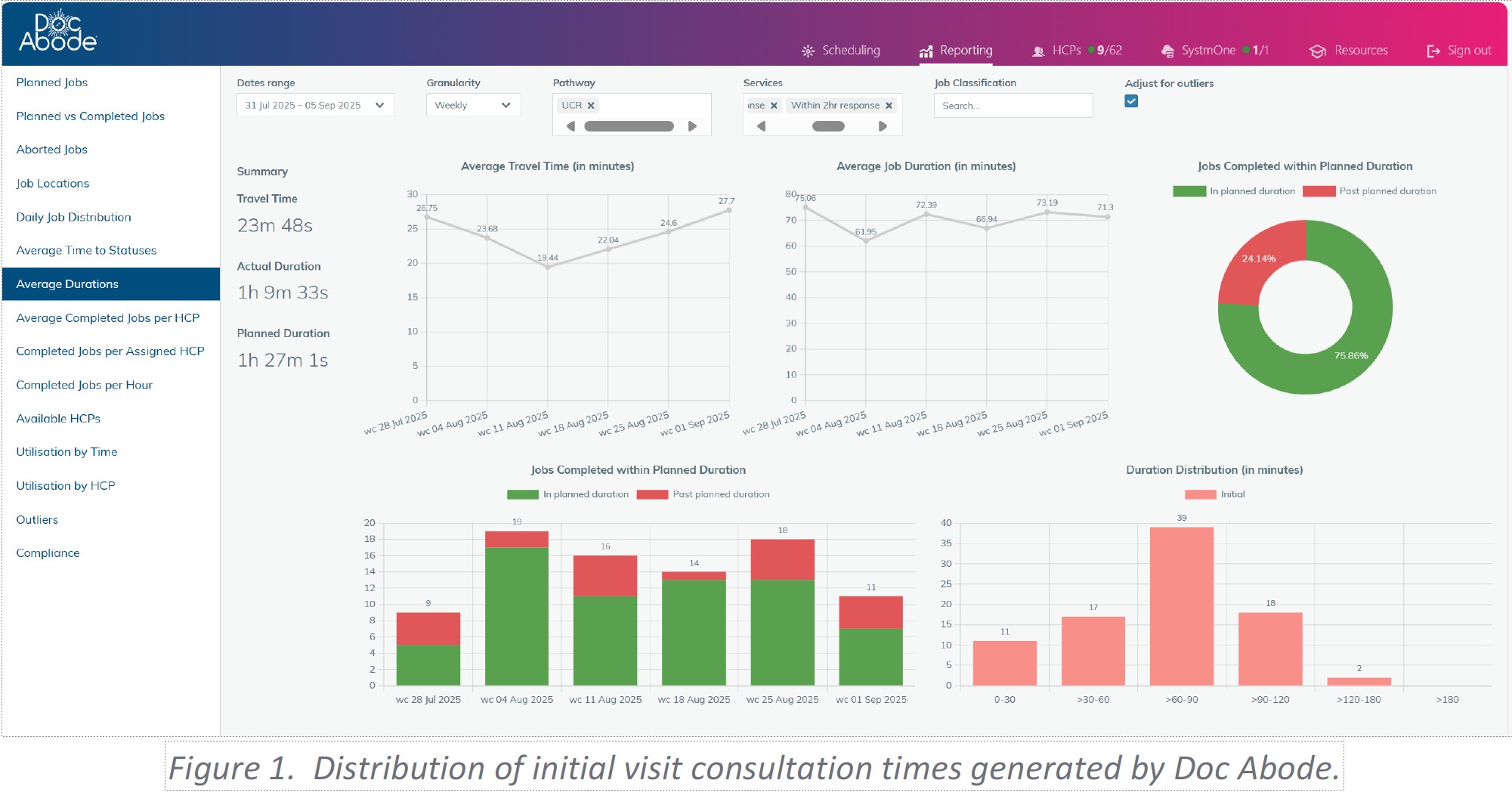
- Reduced visit times from 120 to 90 minutes in Camden’s Rapid Access Services
- Reduced travel time from 30.4 to 26.0 minutes, equaling roughly 73 additional clinical hours per month
- Reduced Schedule Gaps: Eliminated the pattern of premature closing and reopening of daily capacity
- More Accurate Capacity Planning: Shift coordinators can now schedule based on actual visit durations rather than over-allocated time blocks
- Evidence-Based Decision Making: Data-driven confidence to adjust allocations without compromising clinical quality
- UCLPartners ROI modelling estimates £76m per year in NHS savings if implemented across the whole of the London region
Clinician quote
“It has given the autonomy to the clinician. It has given the visibility to the coordinator. And it has given us the confidence to accept referrals we would have previously declined. That is what has helped.”
Arul Bangalore, Advanced Clinical Practitioner, Hospital@Home, and Clinical Lead for Islington Urgent Community Response (UCR) and Virtual Wards
Date Published
August 2026