




Dr Louise Morpeth, CEO, Brain in Hand, and Dr Nicola Doherty, Project & Grants Manager, Brain in Hand
Neurodivergent employees bring enormous value to organisations, including creativity, innovation, problem-solving, persistence, and deep expertise. Yet many autistic and ADHD employees continue to experience poorer employment outcomes, higher levels of stress and burnout, increased sickness absence, and difficulties staying in work over time.
The hidden annual cost of employee sickness to UK businesses has increased by £30 billion since 2018, with most of this increase linked to reduced productivity among people working while unwell (IPPR, 2024). Neurodivergent employees experience poorer workplace wellbeing and psychological safety, alongside barriers to effective support (Birkbeck & Neurodiversity in Business, 2026), reinforcing the need for scalable, practical, evidence-based support in the workplace.
Organisations are under increasing pressure to provide effective reasonable adjustments, improve retention, reduce absence, and support employee wellbeing, while also maintaining productivity and managing costs.
Yet many existing support models fall short. Generic wellbeing apps often struggle to engage neurodivergent users over time, while traditional coaching and therapy services can be difficult and expensive to deliver consistently across a workforce.
What is Brain in Hand and why is it unique?
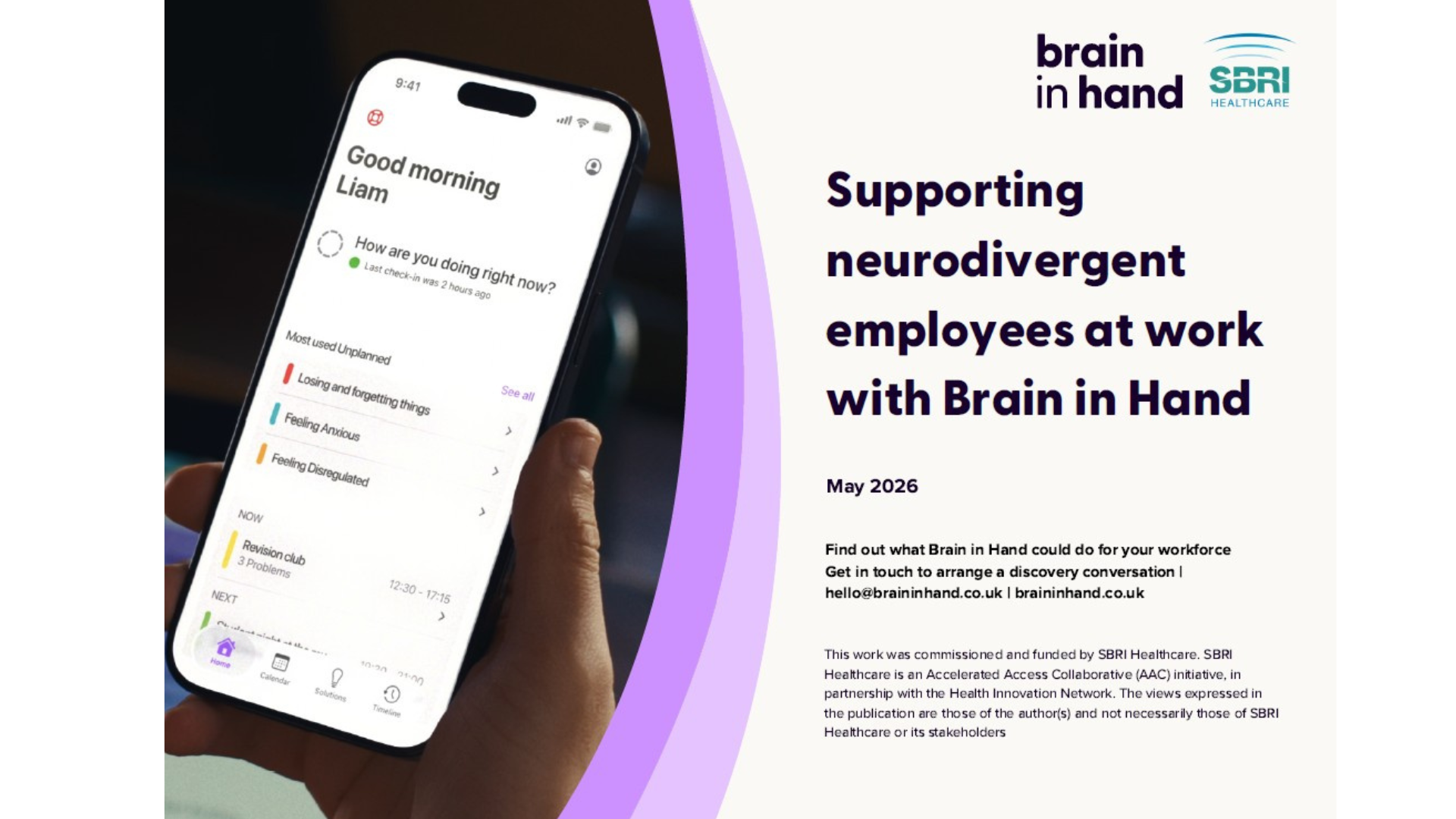
Brain in Hand (BiH) is a hybrid digital-human support system designed for autistic and ADHD individuals. It combines personalised coaching, practical planning tools, mood and energy tracking, and 24/7 human support.
What makes Brain in Hand different is the combination of technology with ongoing human support. While many digital wellbeing platforms struggle to maintain engagement over time, Brain in Hand focuses on practical workplace problem-solving, real human connection, and support that people can access as challenges arise.
What study did Brain in Hand carry out?
We already knew Brain in Hand was making a positive difference for our users in education and health and social care settings, and that there was a growing need for scalable, practical, evidence-based support that supports neurodivergent employees.
What we didn’t know was whether we could demonstrate impact, at scale, in the workplace.
Through SBRI Healthcare funding, Brain in Hand partnered with BIT - The Behavioural Insights Team, part of Nesta, who carried out one of the UK’s largest independent evaluations of workplace neurodiversity support.
One year later, we have our answer.
The study involved 278 employed autistic and/or ADHD participants from a range of sectors, including healthcare, education, charities, and professional services.
Two things stood out immediately:
-
The level of demand for support
-
The extent of unmet need
The level of demand
Usually, on projects, one main concern is whether we will be able to recruit and engage enough people, within a short timeframe, for a meaningful evaluation. In this project, the opposite happened.
Within 24 hours of opening recruitment, we received more than 150 applications from people who met the screening criteria. We had to pause recruitment to consider next steps and make sure the sample represented a range of workplace sectors. When recruitment reopened, we received a further 200 applications within just 15 minutes.
Our focus quickly shifted from how to recruit enough participants to how to avoid over-recruitment while disappointing as few people as possible. It reinforced our sense that demand for this kind of support is high, and that there is significant unmet need.
The extent of unmet need
At the start of the study:
· 91% of participants reported low or very low wellbeing
· 99% were experiencing moderate to high stress
· 70% had moderate to severe anxiety
· 82% reported that their condition had a moderate or severe impact on day-to-day life
· More than a third were considering leaving their job within the next 12 months
· 56% had no tailored workplace adjustments at all
These were not employees who had already received extensive support and were still struggling. Many had been managing significant workplace challenges largely on their own.
What changed over six months?
Participants completed surveys at baseline, three months, and six months measuring wellbeing, anxiety, stress, mental fatigue, productivity, health-related absence, and intention to leave work.
Significant improvements were found across multiple outcomes:
Improved wellbeing and mental health:
· 67% of participants reported meaningful reductions in stress
· 48% reported meaningful improvements in wellbeing
· 42% showed clinically meaningful reductions in anxiety
· 54% reported reduced mental fatigue
Improved work performance:
· 51% reported meaningful improvements in work performance
· Participants became 1.5 times more likely to feel confident at work regularly
· Participants became twice as likely to feel energised at work regularly
Reduced absence and increased retention:
· 71% of those experiencing health-related absence meaningfully reduced it
· 60% eliminated health-related absence completely
· 45% of those at high risk of leaving work were no longer high risk at six months
Participants described becoming more aware of their energy levels and needs, better able to manage workload and boundaries, and more able to work productively in sustainable ways over time.
“I have felt more productive at work because I am more able to prioritise my time and pre-emptively book in rests or time to decompress and also ensure that I'm not overdoing things. This means I've not had any work absences for the past 3 months. This is mostly due to the coaching sessions.” BiH Study Participant
Those who engaged the most were most likely to benefit
Engagement mattered enormously.
Participants who used Brain in Hand consistently experienced significantly stronger outcomes, including almost double the improvement in wellbeing compared with those who engaged less.
Among participants whose health-related absence reduced during the study, 86% had engaged consistently with coaching support.
The findings suggest that the combination of digital tools and human coaching plays a central role in the impact seen.
The research also showed that employees with the greatest level of need at the start of the study often experienced the biggest gains. Those with the highest absence levels, lowest productivity, and greatest risk of leaving work were among the most likely to benefit substantially.
What does this mean for employers?
Most employers we speak to genuinely want to support their neurodivergent employees. The challenge is that many are unsure where to start, what good support looks like in practice, or which approaches make a difference day to day.
This research matters because there is still relatively little strong independent evidence around workplace neurodiversity support.
What we found was encouraging. Improvements in productivity, lower burnout risk, better retention, and reduced sickness absence all have clear value for employers, both financially and in terms of workforce wellbeing.
Based on changes in self-rated work performance and health-related absence, Brain in Hand is estimated to generate £2,400–£3,100 per employee per year in cost savings, with higher savings linked to higher levels of engagement. For higher-risk groups, particularly those already experiencing work absences, this rises to an estimated £7,900–£9,800 per employee per year.
Brain in Hand is estimated to generate £2,400–£3,100 per employee per year in cost savings
The findings also suggest that the greatest impact is often seen among employees with the highest level of need at the start of the study. In these groups, reductions in absence, improved performance, and lower risk of attrition can translate into meaningful organisational savings, while also helping employees stay well and remain in work.
What’s next for Brain in Hand?
Thanks to SBRI Healthcare support, Brain in Hand now has strong independent evidence showing the impact its approach can have for both employees and employers. That evidence has helped build credibility and start new conversations with organisations across the public and private sectors.
Brain in Hand is now focused on developing a scalable workplace offering designed specifically for employers. The goal is to make high-quality neurodivergent support more accessible, scalable, and affordable for employers of all sizes.
At its core, the aim is simple: to help neurodivergent employees not just stay in work, but work in ways that are healthier, more sustainable, and allow them to thrive.
To find out what Brain in Hand could do for your workforce, get in touch at [email protected] | braininhand.co.uk